main

ARMISTICE DAY 2025 and SPLENDOUR ROCK

A special thing has happened to Splendour Rock as has happened to Armistice Day on 11 November at 11am every year.  Each November 11 we now also remember all Australians who died in uniform in WWII (when war came close to Australia) plus all other conflicts.

Armistice Day marked the end of hostilities for WWI on the Western Front.  The fighting was over while a Treaty (signed in June 1919) was eventually negotiated in Versailles.  The Australian Light Horse had a kind of revenge for Gallipoli.  They formed an important part in the final defeat of the Ottoman Turks during October 1918 in Palestine.  The Ottoman Empire was gone.  There was turmoil.  Modern Turkiye was yet to form under Kemal Ataturk.

The “Great War to end all wars” was over.  Yet it was not to be.  Some say WWII was really WWI part II.

In February 1948 four bushwalkers cemented the Splendour Rock plaque in place.  The plaque was dedicated on ANZAC Day 1948.  A list of attendees (possibly 140 bushwalkers) was kept but is now lost.  Equally, the newly established log book seems lost.  The best we can do is the attached list of attendees I have found.

We always known the names of the thirteen bushwalkers remembered at Splendour Rock.  From the book by Michael Keats and I “Splendour Rock – A Bushwalkers War Memorial” we now know that 191 bushwalkers from clubs of the then NSW Federation of Bushwalking Clubs (men & women) served in WWII.

The collection of Splendour Rock log books in the State Library of NSW is patchy.  However, what stands out from the entries is a change in Splendour Rock.  Splendour Rock is changing into a more comprehensive memorial.  Many visitors reflect on family or friends lost in other conflicts.

In this troubled world we do need to remember John Lennon and “Give Peace a Chance”.

Keith Maxwell

Honorary Historian.

———————————————————————————————————————————————————————————————————

DEDICATION 1948 – names

From the Blue Gum correspondence (via Andy Macqueen) in the State Library of NSW there are three further names – Dorothy Lawry, Gladlys Roberts and Alan Rigby.

1948 Dedication names Role or Club Evidence
Paddy Pallin Unveiled memorial  
Stan Cottier Federation President – CMW Four fallen members
Tom Moppett SBW President Four fallen members
Brian Harvey SBW encouraged site selection  
Jean Harvey Wife (depends on children) (like Brian she was a strong walker who also became a life member of SBW)
SBW member 1   Assumption – more members could easily have been present
SBW member 2   ditto
SBW member 3   ditto
Joan Morison YHA Choir See SR book
Bruce Morison YHA Choir See SR book
John Morcutt CMW CMW photo from 25-04-1948
Ken Campagnoni CMW (plaque installer) CMW photo from 25-04-1948
Ron Campagnoni CMW CMW photo from 25-04-1948
Len Hall CMW (plaque installer) CMW photo from 25=04-1948
Paul Barnes SBW (plaque installer) See SR book
Roy Gaddlin Violinist See SR book
Keith Jones Newcastle Technical College BWC See 2004 Bushwalker
Dorothy Lawry SBW Blue Gum correspondence
Gladlys Roberts SBW Blue Gum correspondence
Alan Rigby SBW Blue Gum correspondence
Denis Robinson SUBW email – 14 June 2024
Dave Branagan SUBW ditto
Fred Doutch SUBW ditto
Mick Hammond SUBW ditto
Jack Kelly SUBW ditto
A. Dirks[1] YMCA Ramblers Two fallen members
YMCA Ramblers 1   See GM Minutes 04-1948
YMCA Ramblers 2   ditto
YMCA Ramblers 3   ditto
??? Rucksack Club of Sydney One fallen member
??? Campfire Club One fallen member
??? Trampers Club One fallen member


[1] A. Dirks gave verbal report of trip of YMCA Ramblers to dedication ceremony in 1948 to YMCA Ramblers General Meeting of 27 April 1948.  No number of walkers is listed so more than three YMCA Ramblers could have been present.

Great news for caving

The 2025 King’s Birthday Honours list had three great honours to recognise the outdoors community.  In a happy coincidence it was great news for women, caving and hence the outdoors community generally.

Three honours; an AM & two OAM. (AM – Member of the Order of Australia and the next step up from an OAM – Officer in the Order of Australia). Three special Australians!

Coincidence; how so?  For a decade I have been a serial offender in nominating bushwalkers and now also a caver for an OAM.  In this time, I have learnt three important lessons about this open but increasingly opaque nomination procedure.

Lesson ONE is secrecy.  It is a requirement that your outstanding bushwalker (nominee) and the referees you have selected are all to be unaware of this nomination.  Secrecy makes your research a bit tricky but since there is no deadline you can concentrate on gathering good data on your nominee.  Remember, results are only announced on Australia Day or the King’s Birthday.

Lesson TWO is time.  It takes an unpredictable length of time for a decision.  My successful nominations have taken from 13 months to 24 months or more for a decision.  Nominations especially for women are encouraged at the online portal but the SUBMIT button just adds your nomination to a pile.  After a receipt email there is nothing; with no progress reports.  It seems that your nomination has entered a Canberra black hole.  It is said that there is no preference in assessing nominations.

Lesson THREE is you don’t always succeed.  Not all of my nominations have been successful and no reason is ever given.  Initially, I was told of a failed nomination by name but no longer.

The award of Australian Honours is now more opaque.  Secrecy is maintained to the very end.  Initially, I would be told with a week or so of a successful result.

An obviously generic email is now sent a just few days before a new Honours list is announced with roughly three statements.  One; a decision has been made. Two; check the Honours list for your nominee’s name.  Three; if the name is not there then thank you for your interest in the Australian Honours system.

Coincidence. I know when I submitted my honours nomination.  But in this secretive and unpredictable nomination procedure I do not know when and if one or two persons submitted the other TWO honours nominations.

So, what a great coincidence with THREE successful nominations.

From the Sydney Morning Herald of 9 June 2025 pp. 21-22

Dr Julia Mary James Camperdown NSW for significant service to scientific research, particularly in the field of speleology.

Mrs Dorothy Jean Crabb North Nowra NSW for service to speleology, and to the community.

Mrs Grace Marjorie Matts ESM Bankstown NSW for service to the community through a range of organisations.

(My nomination –

  • Grace and late husband, Don Matts OAM are both well known in the caving community as founders of NSW Cave Rescue.
  • Grace has served as Treasurer for a number of caving clubs.  I know her as a long serving Treasurer and hence part of the Executive of the NSW Volunteer Rescue Association (VRA) where she handled $millions of government funds including VRA squad grants for which she received the Emergency Services Medal – ESM is an exclusive medal limited to the emergency services.  In this latest list of ESM recipients there are just seven from NSW.
  • Grace also has the St John Ambulance Medal for years of teaching First Aid to affiliated squads of the VRA such as the bushwalkers of the then Bushwalkers S&R.
  • Grace has also served several other community organisations.

I was pleased for her.)

Keith Maxwell – Honorary Historian BNSW

SPLENDOUR ROCK – what about the women

Writing the book “Splendour Rock – A Bushwalkers War Memorial” with Michael Keats OAM was a great COVID project.  ANZAC Day is not far off again.  On ANZAC Day in 1948 Bushwalking NSW in a simple ceremony lead by Paddy Pallin dedicated the memorial that had been installed in February of that year.  Thirteen men were recognized as being killed on active service but what about the women.  Our book describes the fallen men in detail.

WWI was mostly a male affair.  Women were present in small numbers mostly only as nursing staff.  Plenty of socks were knitted and ANZAC biscuits baked.  You even had the silliness of white feathers being anonymously sent to repatriated soldiers no longer fit for duty.  Early 20th Australian history is fascinating.  In WWII women were not invisible.

One list I have never seen is the names of those present on ANZAC Day 1948.  Another list I could not find but that I could re-establish was the bushwalkers who served in WWII.  Our book has a list of 191 bushwalkers, young men and women from Bushwalking NSW Clubs who served in uniform from the recognized armed services to the merchant marine and “Australian Women’s Land Army” (AWLA).  One club, the Rucksack Club with almost equal numbers of both genders was noticeable for having more women than men in uniform.
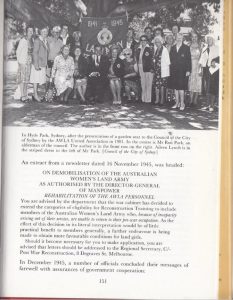
During WWII the Manpower Directorate aimed to control all working age Australians in their occupations (the “draft” in another name).  Eventually nearly 1 million of a population of just 7 million were in uniform.  Many women were keen to serve and several voluntary organisations were formed as well as auxiliaries to the army, navy and air force.  So, not quite full members but still serving in important roles.

Despite the Japanese threat it was not all plain sailing.  There still were older men who resisted change.  Women also went into factories.  It was a different time.  When I first joined the work force there were still tradesmen from WWII who rejoiced in stories of women blushing when asking for a “mill bastard” metal file!

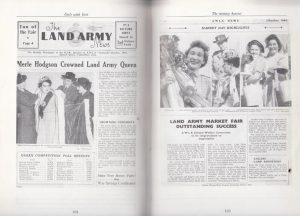
Well after WWII the RSL resisted women from the AWLA marching on ANZAC Day.  They did reneg and allowed them to march at the end of the parade.  Despite this my Aunty Merle had a fabulous time in the AWLA as farm labour and kept in touch with her friends from WWII.  Merle would take my two brothers and I to AWLA reunions as relief (I guess) for her sister.  (We were young and just found the events boring).  When Merle died in 1992, I was asked to be a pall bearer.  Four women I did not know turned up in green blazers.  As we carried Merle’s coffin out of the church, they were there as a “Guard of Honour” for their mate.

In 1994 Australia did recognize the women of the AWLA which was among the civilian groups to be recognized for their service in WWII.  Merle never married so I applied for her medal.  It was slow to arrive but was well presented so after showing it to our children and taking pictures of it I posted it to my cousin who had looked after Merle in her later years.

Australian women did play an important role in WWII.  We may never fully know how many women were involved as code breakers.  They were told to keep it a secret, and that it what they did well past 1945!
There are three great books I would recommend regarding Australian women in WWII and the authorities they served with –

Scott, Jean. Girls with Grit 1986. Allen & Unwin – ISBN 994 04 ‘2’ 088042.  A history of the AWLA that includes my Aunty Merle as “The Land Army Queen”.

Adam Smith, Patsy. Australian Women at War 2014. The Five Mile Press – ISBN 9781760062637. The “Abbreviations” shown on p. 379 lists all Enlisted Services for Women and Men plus Decorations etc.

Duffy, David F. Radio Girl: the story of the remarkable Mrs Mac, pioneering engineer and wartime legend 2020. Allen & Unwin – ISBN 9781760876654. An excellent read that mentions many voluntary women’s groups in WWII and the fight to be accepted.

Maxwell, Keith & Keats, Michael OAM. Splendour Rock – A Bushwalker’s War Memorial 2023. Design Portfolio – ISBN 978-0-6487913-2-4. This great reference is available where you find all good bushwalking books in the Blue Mountains or via the Bush Explorers website at https://bushexplorers.com.au/catalog

Keith Maxwell.

Honorary Historian BNSW.

Kimberley Wilderness Expedition

Kimberley Wilderness Expedition by Stephen Millard

Imagine a National Park that is so remote that it has no signage or roads, but has books published about its trove of unique and ancient rock art: think of Drysdale River National Park in East Kimberly. Last June we were invited by fellow Byron Hikers Club members on a 12 day commercial adventure so inaccessible that we had to fly there in a float plane and land on the Drysdale River.

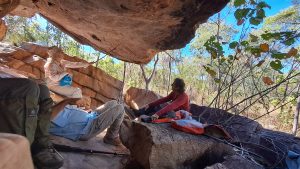
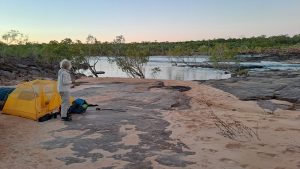
After landing next to a shallow sandy beach and unloading our packs and the food, we set off on an easy 7 kilometre walk through tall grass along the river bank. After several cooling-off swims and lunch, we arrived at our first camp which was on an expanse of smooth rock right beside the river. Our guide, Sebastian, soon had a 3 course dinner prepared for us. It started out with a first-day luxury; perfectly ripe Haas avocados with Seb’s own vinaigrette dressing, rice crackers with re-hydrated hummus and beetroot dips followed by pasta with lots of veggie chunks that Seb had dried himself. All the other evening meals were amazing and featured treats such as creme brolee with rehydrated mango cheeks.


We visited the first of many rock art galleries the next day, not far from our river camp. The paintings included figures that had been termed ‘Bradshaw’ and are now known as Gwion Gwion. They are very fine-lined pictures, often of dancers in elaborate regalia that had been recorded in early photographs of local Aborigines as well as animals like the extinct thylacene and ghostly Wandjina figures. Ochre has been colonised by cyanobacteria to make indelible ‘paint’ that even survives galleries that are flooded during each wet season. The only reliable way of dating these works is analysing wasp nests that may have been built over a painting. The oldest such nest goes back 24,500 years! And that might only be a fraction of their age! As we visited gallery after gallery we kept thinking about what was happening in other parts of the world back then, tens of thousands of years before the advent of agriculture in the Middle East or the pharaohs on the Nile. It is mindboggling.


We followed the river downstream for the next few days visiting art sites in shady rock overhangs and camping on stunning river beaches. The river diverted to the east, swung north, then west around three sides of a giant square shape. We walked away from the river through lightly timbered dry savannah in a northerly direction along the fourth, ‘western side’, using one of many fault lines in this plateau of rock to descend a rocky escarpment back to the river. Salt water crocs potentially inhabit this section of the river, even though it is about 100km upstream. Hence we were careful not to swim in the main stream.


After several more days exploring the terrain and more art whilst moving upriver, we scrambled around the 30 metre high Solea Falls which prevent crocs going upstream. It was relaxing to know that we could swim safely again. After 9 days we were back at our first camp site where we picked up a stash of more food that enabled us to do a final 3 day loop up Planigale Creek. We camped on two different ‘quiet’ cascades, this being a much smaller watercourse than the Drysdale. At the second camp the stream slid about 5 metres over a waterfall into a rock pool as big as several tennis courts. Seb had observed freshwater croc tracks on our way in but we didn’t see any crocs despite much swimming. The next day we had 5 brolgas flying above us as we explored more creekside galleries. They eventually landed just downstream from where we stopped for lunch.

Although every camp on the hike was different, every one was a ‘to die for’ location. On the last day we used another faultline to break out of our ‘continent’ of rock that prevents any vehicle access to this whole area. We were then in an island of savannah that contained a number of small wetlands until we reached the original plane landing site. Here we swam and camped for the last night. The float plane picked us up the next morning as planned. As it droned over the rocky landscape back to Kununurra, I kept thinking about the land below that was so full of rock art and so empty of people. Black fellas moved into a mission to the north a century ago and have never gone back. Only a few of us white fellas have ever visited this magic land. Only a handful of people like our guide have made the effort to explore this remote wonderland.

Initially I couldn’t get my head around the cost of $6000 for this trip because I’m a do-it-yourself hiker who had never paid for a guided trip. Turns out it is quite reasonable considering the first plane airfare is a large part of the cost and that Sebastian is a legend as a guide in the Top End. For me it was a trip of a lifetime and worth every cent. We are recommending it to our Club members for this June.

We used the ‘Mount Connelly’ map on Avenza. Search Gwion Gwion in Wikipedia for rock art references. See here for details of this June’s expedition.

Canberra Bushwalking Club ACT Top Ten Peaks

ACT Top Ten Peaks
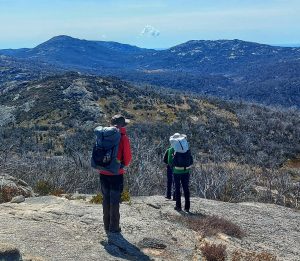
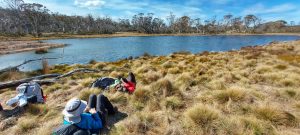
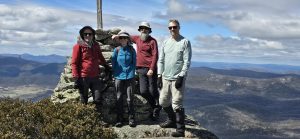
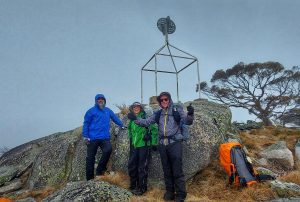
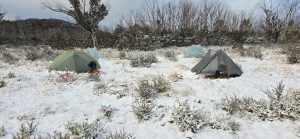
A party of four intrepid CBC walkers, led by Stephen M, have just returned from six days of bushwalking in the remote areas of Namadgi NP. Much of the walk was along the trackless, rugged ranges that make up the ACT/NSW border.
The objective was to visit the 10 highest named peaks in the ACT. Unfortunately, the untimely snow, ice and strong winds conspired to abandon an attempt on two of the peaks (Mts Namadgi and Burbidge). Still, they had an awesome time walking in the spectacular and wild country right on our doorstep.
We are very fortunate for the hard work of those who were instrumental in securing this wilderness area as a National Park.
Happy 40th Birthday Namadgi NP!
Photo credits: Kirk H, Daniel P, Jacqui R, Garry B

Sydney Christian Bushwalkers turns 50

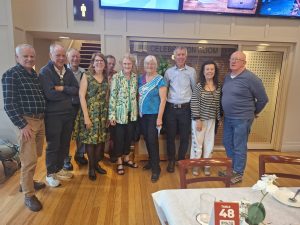
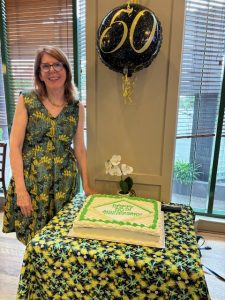
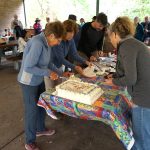
Sydney Christian Bushwalkers recently held 50th birthday celebrations over a weekend of walking in the Kiama area, followed by a dinner at Burwood RSL Club. The events attracted current and former members, who are pictured below in a group photo. In the second photo, the anniversary organiser Judith Ramm poses with the 50th birthday cake.

The non-denominational Christian bushwalking club, Scripture Union Bushwalkers, was founded by the first club president Graham Morrison in July 1974. The inaugural walk was an overnight trip to Blue Gum Forest, in the Grose Valley near Blackheath – very cold at that time of year! A few years later Peter Onus took over the role of president.

The club had quite an active program of day-walks, overnight walks, and multi-day treks in those early years of the 1970s, 1980s, and into the early 1990s, with full use of Easter weekends, October long weekends, and Anzac weekends. Naturally there were numerous day-walks as well, which were the mainstay of the program. Some of the day-walks were fairly easy, while others could be quite hard and rough, occasionally including bushy and rugged off-track sections.

In the late 1980s and the early 1990s the number of members who liked overnight walks gradually reduced as people went their separate ways. As a result, day-walks became the main feature of the club’s program, complimented by occasional overnight walks.

In the new millennium, Scripture Union decided that any affiliated groups should follow the organisation’s policies and procedures. The club members considered that the link with Scripture Union had become tenuous, and a stand-alone club would be the better option. There was some debate over the name change, but eventually Sydney Christian Bushwalkers was incorporated, with its own policies and procedures appropriate to a bushwalking club.

Although membership numbers have declined, to remain steady around 67, the club has continued to have an active program. Many of the older club members have been in the club for several decades, and as the general membership age has increased, the type of walks has changed to moderate and easy walks on a Saturday, mixed with occasional urban walks and car camping or cabin weekends.

Christians of all ages and denominations are welcome, and visitors can attend 3 walks before being asked to join the club.

November 11 – a new name for an Honour Roll

November 11 is not far away, and many Australians will pause at 11am for a minute to reflect on the end of the mass slaughter that was so much a part of “The Great War” that was to be “The War to End All Wars”.

Of course, WWII was just twenty years away and the sons of many AIF (Australian Imperial Force – the Australian Army) servicemen in turn (such as my uncle) served in the Second AIF when Australia was seriously threatened in the Pacific Campaign.

From the book on “Splendour Rock – A Bushwalkers War Memorial” by Michael Keats and I we know that 191 bushwalkers (young men and women) served in uniform with 13 bushwalkers now being remembered at Splendour Rock.

But perhaps another name should be considered as a victim of WWII although it was before 3 September 1939.

The guns fell silent at 11am on the 11 November 1918 but the war was not over until the Treaty of Versailles was signed in June 1919.  While this Treaty tried to avoid a future war by limiting the size of armed forces worldwide it failed.  Japan felt slighted from not being treated as an equal to the European nations and Adolf Hitler convinced the Germans that Germany had been stabbed in the back by the Allies (not correct).

In 1939 the drums of war were beating as Neville Chamberlain, Prime Minister of Great Britain tried to negotiate with Adolf Hitler to avoid war.  Recently, Jeff Howard a past President of CMW mentioned a club member who died while training as a RAAF Flying Officer.

Maxwell Leonard Hickson joined RAAF on 17 January 1938 so would seem to have seen troubled times ahead.  On 29 April 1939 he was one of two pilots, and two other aircrew killed near Riverstone when an Avro Anson bomber crashed.  From what Jeff Howard can see in early CMW records Max would have been close to a foundation member of CMW.

So, Maxwell Leonard Hickson was prepared to serve in WWII and thus there is a strong case that he should be remembered as one of the fallen bushwalkers Bushwalking NSW recognises at Splendour Rock.

Keith Maxwell.

Honorary Historian BNSW.

The Bush Club – 85th Birthday Celebrations

The Bush Club

Bush Club Birthday Celebration Walks

The Bush Club came into existence on 19th September 1939. The Club was founded by Marie Byles and Paddy Pallin. Both Marie and Paddy believed that the rigorous standards of the tests, pack walking etc., for gaining entry to bush walking clubs was too high. They believed this prevented those who simply want to walk in and appreciate the bush from joining clubs. Their belief was that a love of the bush and a willingness to protect its environment should be the main qualification criteria along with making friendships through bush walking. These core values remain the same for the Bush Club today.

Today the Club has 890 members. While the Club has grown considerably over the years it remains thru to the core values of its founders. The Club places great emphasis on celebrating the creation of the club each year. We mark certain milestones with special events.
The Bush Club celebrated its 75th anniversary in 2014 by completing club walks in 75 national parks all over the world. The walks ranged from the Blue Mountains, the Lake District in England, Horton Plains in Sri Lanka to Los Glaciares in Argentina and were completed between May 2013 and end of August 2014. See here for more information.

The Club celebrated its 80th anniversary in 2019 by completing 80 different club walks by 80 different leaders. The walks were completed between December 2018 and October 2019 from the Ophir Goldfields in NSW Central West to the Garden of Stone and as far afield as the Kerry Way in Ireland. More info.

This year we celebrated the 85th Birthday of the Bush Club. We asked our Leaders to put on 85 ‘trig’ walks / cycles to mark the occasion. As always, our Leaders responded enthusiastically and completed the 85 ‘trig’ events. The trigs were visited between October 2023 and October 2024. These walks and cycles took place throughout NSW, Interstate and the Lake Dunstan trig was claimed on a Club cycle in New Zealand.

All our special birthday events are recorded and a page created on the Bush Club Website for future members to look back on and continue the tradition into the future.

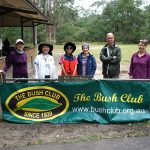
Along with the special occasions, we celebrate the Club’s birthday each year with walks to a central location within a National Park around Sydney. This year the walks finished at Commandment Rock, Lane Cove NP. There was tea, coffee and the birthday cake. We had in excess of 50 members attending the celebrations.

Topographic Maps of NSW 2022 Series

Please note that Bob Sneddon is the sole author of this article.

Topographic Maps of NSW 2022 Series by Bob Snedden

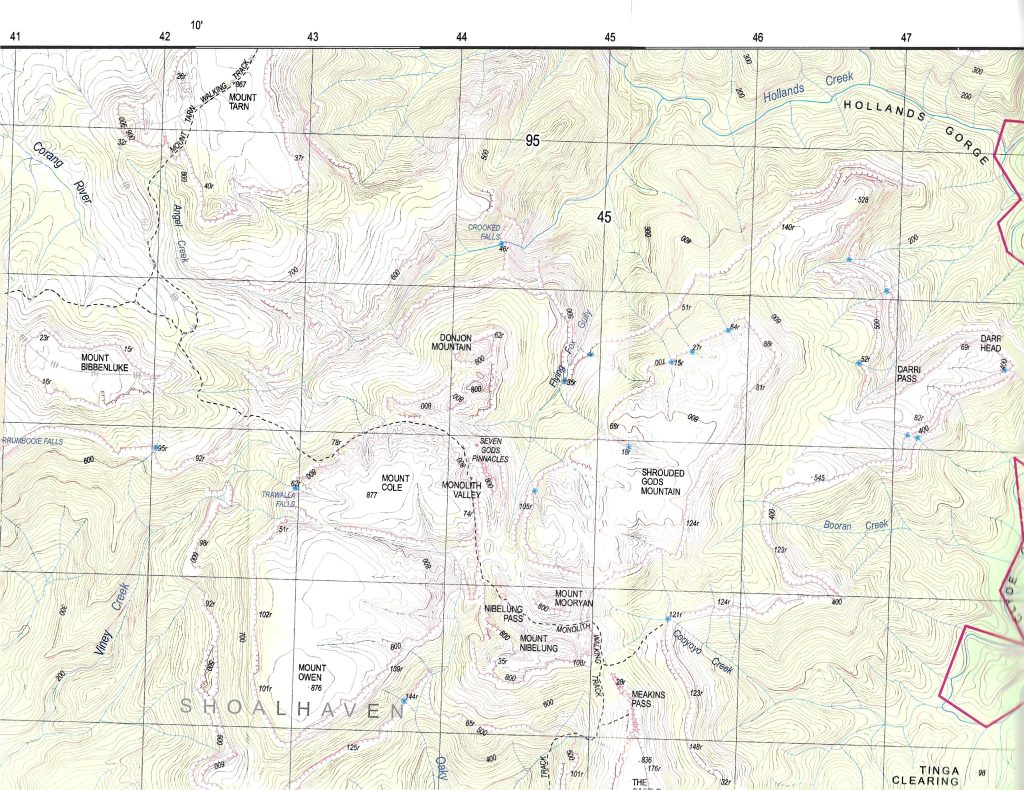
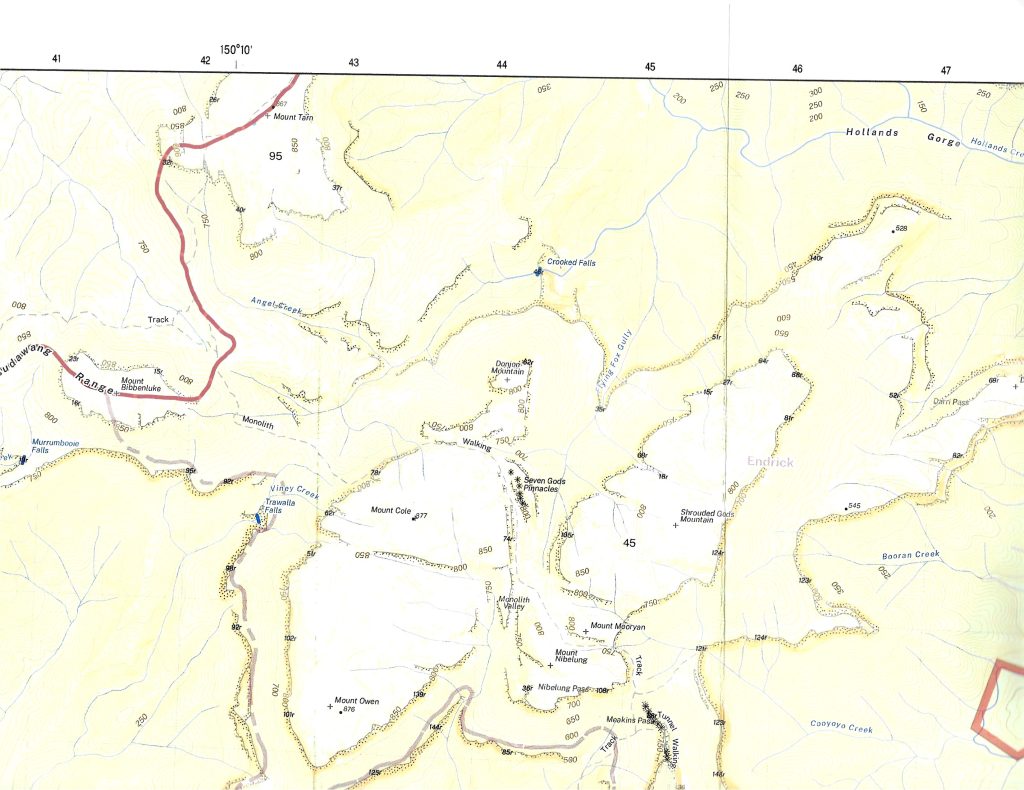
The defining feature of topographic maps are the presentation of the form of the landscape topography via the contour lines. Along with this are the vertical and horizontal grid coordinates for the “Grid References” and “GPS positioning”. The current 2022 Series fail to do this, rendering the maps unfit for purpose and therefore presenting something of a risk to the user. Those who rely on accurate landform information e.g. Rural Fire Service, NSW NPWS and bushwalkers will be directly affected. After examining 20 maps in the 2022 series covering the south coast region, from one outlet all were found to be similarly deficient.

In recent years the need to review the cost of paper map production has led the mapping authority i.e. “Spatial Services” away from the use of traditional lithographic printing. Map production is now outsourced and print production is via the use of laser digital print process. There has also been a departure from pre final run proofing and quality control. The usual casualty of department restructure has been a significant loss of intellectual content. As often happens, a renewal of a departments intellect does not mean and automatic continuity of policy. On the technical side, there is today an assumption that what you see on the computer screen is what will appear on paper. This is Not necessarily the case.

As part of the stream lining of map production, map reprinting is also subject to an “Auto generation” process whereby a reprint is initiated automatically, evidently governed by “barcode” stock records.

The deficiencies with the current 2022 series lies with the preparation of the original computer file provided to the printer. Although the contour lines and grid reference lines appear on the digital version, as seen on the computer screen. This is not what occurs with the laser printed paper copy. The defining map features are there, but virtually indistinguishable.

It is not a new problem for anyone familiar with printing processes. It just reflects the current trend of a departure from traditional approach to quality control. In short there needs to be attention given to the combination of colour selection, printing process and print stock i.e. the actual hard copy paper.

After protracted discussion issues regarding place names I have been advised:

“Spatial Services is still running an old auto generated PDF series which doesn’t include any of the updates you had suggested over the years. Business priorities have led us in different directions and whilst it remains an aspiration to produce, I can’t put a timeframe on when that might happen. Further, the circumstances remain the same in that an auto gen product doesn’t deliver the same level of information and annotation as the old traditionally produced map series”.

Errors in books, are often set aside as “typo’s”. With maps it is more than that. Where topographical information i.e. contours lines cannot be clearly distinguished and place names are incorrect, (an ongoing problem), it becomes a serious matter, critical to public safety. There is an assumption and indeed an expectation maps will be correct. The absence of critical topographic information renders the maps useless for field navigation. In the case of areas of known risk such as the southern part of Morton National Park where it surrounds the former Tianjara Artillery Training Area. The poor presentation of topographical information impacts on the management of use patterns, safety and duty of care, and can include the operation of other stakeholder activities.

Both the printer and “Spatial Services” have been advised of the deficiencies with the current series 2022 maps. Spatial Services where the files originate have stated (as above), they are aware but have no plans to correct the issue in the immediate future. It is unfortunate that “BUSINESS PRIORITIES have overtaken safety concerns and for the Government agency to be producing a product that is unfit for sale is unacceptable. Spatial Services claim they undertake appropriate proofing and quality control measures but this is clearly contradicted if one compares the 2017 and 2022 series.

A recent practice by some, is to download the map and print off the relevant section of interest. Some venture to say you can massage the file, but this requires a degree of skill using special graphic software to enhance to contours etc.

In my own view scrolling around with a computer in the field can be impractical and just grabbing a relevant section of the map does not adequately replace the spread of the full map especially when the overall terrain is unfamiliar.

All these opportunities are possible and will be argued by some. None the less, it remains the current 2022 series of maps are unfit for purpose and should not be on sale, and the “Autogen” process for restocking should be abandoned and the maps withdrawn from sale until there is a decision to correct them.

Stakeholder groups and their members e.g. Bushwalking NSW, conservation group and Rural Fire Service are encouraged to express their concern to the map publisher NSW Department of Customer Service -Spatial Services.

Bob Snedden –
Bawley Point NSW 2539
9th September 2024


Iluka Day Walk – Clarence Valley Bushwalkers

Iluka Day Walk 18 August 2024 – Clarence Valley Bushwalkers Trip Report, by Christine Casey, Secretary

As Christine noted “We are very lucky in this part of the world to have rainforest and beaches right next door to each other, with a river ferry ride thrown in”.

On a perfect winter’s day ten of us met at Yamba jetty for a ferry trip across to Iluka, where we met up with another two of our bushwalkers, to walk around the foreshore to the World Heritage listed littoral rainforest at Iluka.

Although we have done this trip a number of times before, each time it is different. This time we did not have an East Coast Low sitting off the coast, blowing so hard that the National Park was closed, and generating massive swells and waves that threatened to sweep us off the breakwater.

Nor was there a power outage that closed the coffee machines in Iluka. And the track through the rainforest wasn’t so flooded that we had to either bush bash through the smilax creeper or wade waist deep the dark tannin stained creek that used to be the track.

This time we just had a cool westerly wind at the Yamba that had us pulling on jackets and fleeces, then finding shelter downstairs in the ferry for the crossing. Morning tea was in Iluka’s riverside park, out of the wind and in the sun.

The walk itself was relaxed and enjoyable. Conditions were very dry through the rainforest, but cool and shady under the tall canopies covered in vines and epiphytes. National Parks had gone to a lot of effort to replace the old faded signage along the track and at Iluka Bluff picnic shelter. There were now impressive new versions with interesting information about the birds, plants and landforms along the track.

We had lunch at the beach and picnic area at Iluka Bluff then returned in time to catch the 2:30 ferry back to Yamba. Another very pleasant day with friends enjoying our spectacular part of the world.