main

Tourism development in protected areas: Are we on the right track?


Tourism development in protected areas: Are we on the right track? 

Bushwalking NSW symposium 19 November 2022

Thank you to our Sponsors:

Summary

Keith gave a stirring call for the protection of nature and for retaining nature intact. See last slide for summary. Also, click here to watch the Symposium video and here to see the Agenda.

Speakers

Andy Macqueen – The Historical Perspective

  • the 90 years anniversary of Blue Gum Forest celebration is also a celebration of all national parks and the amazing legacy of Miles Dunphy
  • also discussed evolution of the conservation movement

Gary Dunnett, National Parks Association of NSW Executive Officer

  • NPA of NSW was established in 1957 to protect nature through community action
  • The National Parks Australia Council is concerned about proposals for commercial developments in Protected Areas
  • believes Protected Areas Management is veering off track

The findings of the 2021 NPAC national survey of community attitudes on development and commercial activities in Protected Areas reinforced:

  • the important protected areas purpose of nature and wildlife protection for current and future generations
  • Australians are twice as likely to visit national parks with low impact commercial tours compared to high impact activities
  • Any visitor services should be small scale, low key, of value to all visitors, and in keeping with the natural setting

Shadow minister for the Environment, Hon. Penny Sharpe

  • Labor’s task is to prioritise environment protection by increasing protected areas, curbing land clearing, establishing market based mechanisms to address climate change and retaining wildlife corridors
  • believes national parks have been downgraded – and we need to elevate NPWS status and increase importance of POMS
  • said invasive species issues are getting out of hand

Andrew Nicholls PSM, Acting Deputy Secretary, NPWS

  • The NPWS acquisition program focus is on under-represented areas of land
  • Australia is the world leader in extinctions – 85% of threatened species live in national parks. 
  • NPWS has a zero extinction policy eg feral animal control, reintroducing locally extinct mammals
  • 30% parks estate is managed jointly with traditional custodians
  • A key issue is stewarding parks due to increasing visitor demands on parks – the POM is the key tool used to balance conservation and recreation 
  • NPWS will use existing infrastructure where possible and will develop new camping facilities where needed. Options for those who want to pay more will be available
  • Economic benefits from national parks will flow to regional economies
  • NPWS will work within national parks legislation using a precautionary approach and consulting with the public

Private Tourism sector perspective from Mark Norek, Life’s an Adventure

  • Mark’s sustainable tour business model is to buy land near national parks for infrastructure, use local infrastructure and support local businesses. Accordingly he is adamant that there is no need for development in national parks. 
  • Outlined how his business principles have been successful with these walks –  Bay of Fires, Three Capes Walk, Light to Light and Kangaroo Island 
  • worried that NPWS is losing their direction and working for the big end of town

University researchers Ali Chauvenet – The Hidden Mental Health costs of the privatisation of parks

  • being in nature is good for our health – parks contribute $5000 per person per year in mental health benefits
  • without national parks there is double the amount of mental health costs 
  • parks privatisation increases the gap between those who do and don’t go to parks due to socio economic factors
  • there’s a missed opportunity for leveraging funding via mental health benefits but this needs to be inclusive and equitable
  • mental ill health is expensive and pervasive

Conservationist perspective from Keith Muir, Wilderness Australia

  • Questioned if the next generation will even know how to engage with nature
  • Parks development leads to more development and nature destruction not nature appreciation 
  • Partial privatisation is exclusive beach front development by stealth
  • The public are excluded from secret government/developer lease negotiations
  • Commercial built development in parks should be legislated against 
  • Local communities are bypassed and do not receive an economic benefit from high-end development
  • Multi use trails are a myth as they displace walkers in place of bikes etc
  • Green Gully developments are non-compliant with legislation. Horse riding negatively impacts on wilderness through weed spread
  • NPWS conservation role has been diverted to tourism management
  • Need to reinforce importance of ecological sustainability – manage parks for nature not humans

Legal perspective from Christopher Birch, SC

  • Gave a clear answer to the question: What stops development in National Parks?
  • While the PoM is the key instrument, the minister has powers to amend a PoM with only 45 days public viewing eg Beowa PoM was amended to allow hard roof accommodation development
  • The minister has extensive powers to grant leases and licences making it very easy to replace NPWS with a commercial operator.
  • EPA process: once the PoM is in place, environmental impacts are reviewed. Only have to examine and take into account environmental impacts as The Act doesn’t require impacts to be addressed. 

NPWS Greater Sydney Regional Advisory Committee perspective from Brian Everingham

  • Preserve Park Protection for Posterity
  • Educate younger generations to appreciate that national parks offer more than a backdrop to modern high-tech activities
  • More money for weed controls in National/State Parks
  • Protect national parks and use existing nearby infrastructure
  • Primary purpose of a park is conservation not commerce
  • The more we talk together, the stronger we are
  • Train young people to guide walks and maintain tracks. NPWS to run these projects and attract more people to walks.

Presentation Summaries:


2023 Online Systems Club Survey

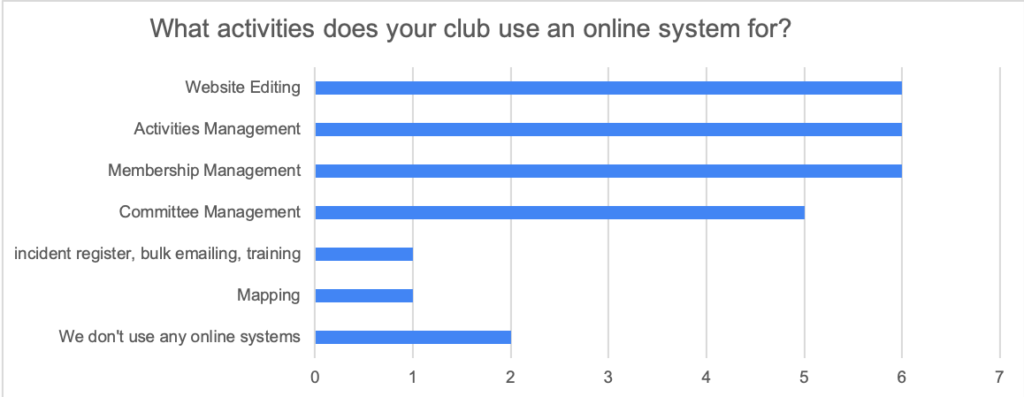
Ten members from nine (13%) of our clubs responded to our Online Systems Survey (the survey is still open). All but 2 (20%) use online systems. They use online systems for:

Membership Management, Activities Management and Website Editing are all very popular targets for online systems used by 60% of clubs surveyed.

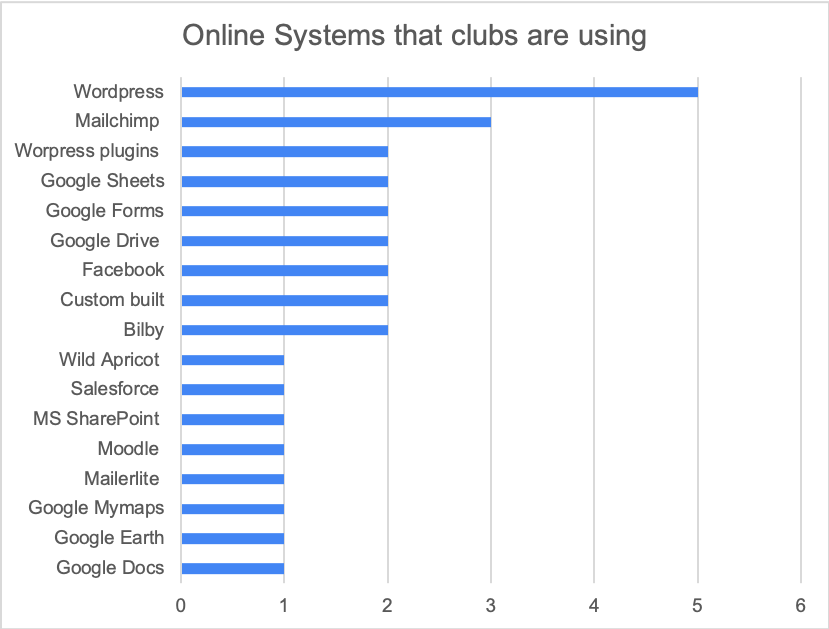
Now here’s the good stuff for you: These are the systems that clubs use:

Six (60%) of respondents said they would like to use more electronic systems. The systems they are interested in using are:

  • The 2 clubs that don’t have Membership Management, Activities Management, Committee Management, and Website Editing would like them
  • Another 2 clubs would like to further enhance their Activities Management:
    • integrate activities management into salesforce or upgrade our current system
    • Leader Resources, specifically a list of activities (walks) with information a leader requires to find an activity to lead and offer it themselves
  • Skills development, specifically around navigation
  • Online forum with other club committees and leaders to discuss club stuff
  • image management and route management
  • Open Street Maps
  • History, photos, maps, walk details, club records.

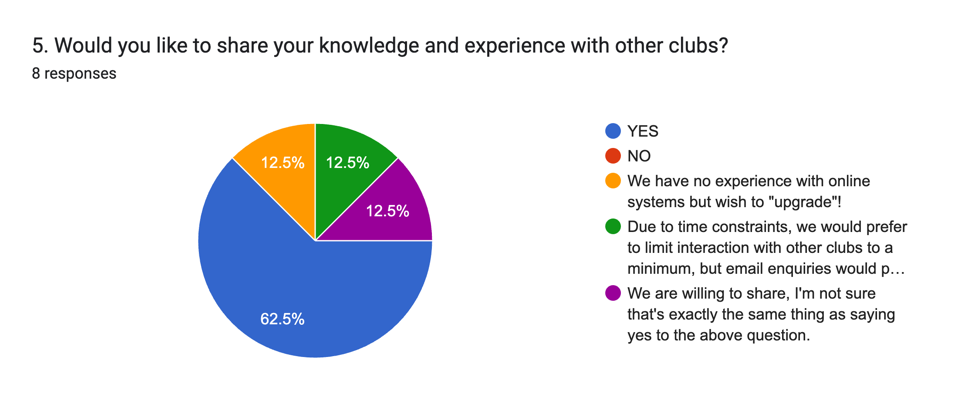
The wonderful news is that the majority of clubs would like to share their knowledge and experience with other clubs:

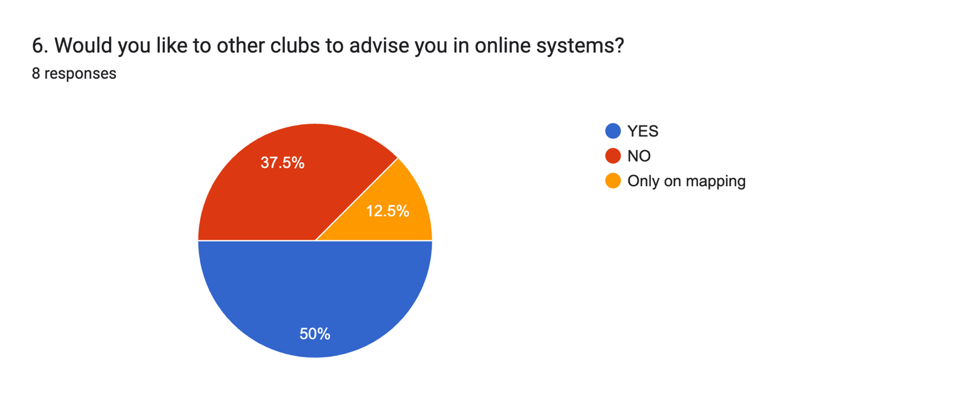
Some clubs are also looking for advice so BNSW will set up an online forum to discuss online systems!

Would you like help to manage your club using online systems?

Complete our Online Systems Survey now and join us on 16th May 2023 meeting where Peter Whitely, Northern Rivers Bushwalking Club Membership Officer, will introduce us to Member Jungle membership and activities management system. Registration essential.

ANZAC Day is near

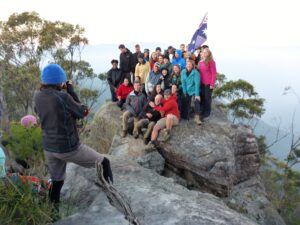
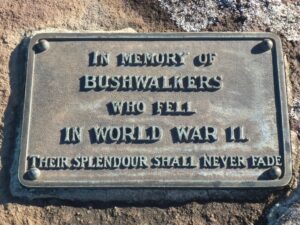
ANZAC Day is not far away so your mind may be turning to the special memorial at Splendour Rock that remembers 13 bushwalkers (from bushwalking clubs of Bushwalking NSW) who did not return from World War II.  This memorial in the Megalong Valley of the Blue Mountains must be Australia’s most remote war memorial.

You may or may not be aware of some other memorial plaques at this site.  A new book by Keith Maxwell and Michael Keats OAM should be on your bookshelf.  It is the definitive work that is bound to become a valuable reference on Splendour Rock with so much information.  It answers so many questions.  For example,

# Who found Splendour Rock plus when was the plaque installed and by whom?

# When was the memorial put on the official NSW register of war memorials and Australian War Memorial?

# Who are the bushwalkers remembered and what did they look like plus who were the bushwalkers who served and returned from WWII?

# How did the bushwalkers at home support their friends in uniform?

# How have these bushwalkers been remembered at ANZAC Day Dawn Services starting in 1948?

# What are the other memorial plaques including on the Central Coast and in a North Sydney church?  What is their story?

# How have fallen NZ (of ANZAC – New Zealand) trampers been remembered?

# What is the bushwalking club founded by a walk to Splendour Rock?

With 360 glossy pages it is a great read packed full of so much information plus pictures and early maps.  A must for every bushwalker’s bookshelf.

Splendour Rock – A Bushwalkers War Memorial by Keith Maxwell and Michael Keats OAM is available at bookshops where you find other great bushwalking books or from the website – bushexplorers.com.au (postage free at $66)

Keith Maxwell.

The Splendour Rock Choir from the Illawarra Grammar School.

How to set up a new bushwalking club – Coffs Hikers story

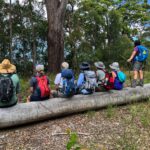
On a sunny day in spring 2021, a small group of keen walkers met at the Botanic Gardens in Coffs Harbour to discuss setting up a bushwalking club. But how do you set up a club?

This is our story. We hope sharing will help others on their journey to start and manage a bushwalking club.

Start with why, then how

We began by discussing our values, which determined the form the club would take. We agreed to set up a not for profit incorporated association and to affiliate with Bushwalking NSW Inc. This provides legal protection and insurance for our volunteer and members, allowed us to open an association bank account and get an ABN (useful for grants), and to benefit from knowledge shared within the NSW peak bushwalking organisation.
The minimum number of members for an association is 5 – we met that. Next we needed a constitution, and that required making some early decisions. For example, did we want to set a maximum period for serving on the committee to prevent burn out and stagnation? What membership classes were we going to have, and could children be members? We sought input from other clubs, and opted to keep it simple.

Once the constitution had been debated and finalised, our first committee was formed. The newly appointed Public Officer was given authority to go ahead and lodge with Fair Trading, incurring our first expense. Two days later, our application was accepted and Coffs Hikers came into existence. Our domain name was registered, and work began on a website.

We went to the bank to open an account and also set up a Business Account with PayPal so that we could support online payment of fees. PayPal charge of course, but they manage all the risk around credit cards and compliance, and we were comfortable paying for automation that eases the burden on our volunteer Treasurer. We set our annual membership fee at $35, to cover insurance premiums and fund the website, with a little to spare. Our first ten members signed up and paid their fees.

Once again, our group met at the Botanic Gardens to discuss our first activity program. Talking about walks is way more fun than constitutions! The final step in the process was completing the forms for affiliation with Bushwalking NSW Inc, and paying our first insurance premium. This was done in late November, just in time for our first walk on 4th December 2021.
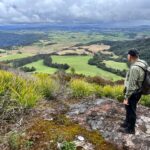
So, there you have it – from initial discussion to incorporation, affiliation and first activity took us two months.

Automation reduces administration

We like to walk, but we’re not so keen on admin. We would rather not have to nag people to pay fees, or update membership registers, or, as leaders, have to remember who signed up for a walk and who cancelled and how many are coming now and what is that new person’s name again? Fortunately, we had a committee member with website skills.
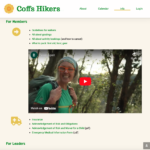
The aim was a modern, low cost, mobile-friendly website that was easy to use for members, volunteer leaders and committee members. Before digging into the details of the technology used, let’s begin with some thoughts on how to simplify website building.

We built what techies call a “minimum viable product”. This avoids getting bogged down in committee discussion, designing an overly complex solution. We got a basic site up quickly, and learnt from that. We also tried to avoid reinventing wheels. For example, we link to Lotsafreshairs excellent videos and the Bushwalking Manual, no need to write your own.

Lastly, it’s important to be flexible with club management processes. For example, fees can be charged on a fixed calendar year (January to December for example, with discounts after July, and further discounts for families and concession cardholders). Or they can be like a gym membership, on a rolling 12 months from the date you sign up, with no discounts, auto renewed. For us, the second option was simpler and easier to implement.

Let’s get technical

As a new club with hardly any money needing a website fast, a bespoke outsourced solution was never an option. We considered club management software such as Wild Apricot, but were put off by the high price and concerns that it attempts to do everything without excelling at anything.

So, we went for a mix-and-match approach based on WordPress, combining different tools that play nicely together. WordPress iswell-known and widely used, development skills are readily available, and it is easy for volunteers to use. While we had the luxury of a member volunteering her time, we wanted to ensure others could maintain the site in future. Cost was important too: WordPress itself is free, with a large market of competitively priced plug-ins.

Before we could start building a website, we needed hosting for our website and chose Siteground as they have servers in Australia.

The website took about two weeks to set up and test, ready for opening our doors to new members. There was some maintenance work in the first few weeks of operation, as we refined our content and processes, but ongoing website maintenance is now light.

MemberPress provided us with a login system and the ability to restrict content to members only. We set up two membership classes (Trial, Full members) with different fees. We created an online membership form with a digital acknowledgement of risk and connected it to PayPal. We also provide an option for payment by bank transfer, but hardly any people have used this.Members can update their information, if their address changes, for example. Reminders are automatically sent when membership is due for renewal. We created roles for Committee Members and Leaders, who have access to extra functionality.
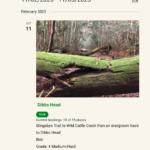
We installed The Events Calendar to manage our program of walks, cycling, kayaking, meetings and social activities. A calendar overview is available to the interested public as this encourages new members to join, but only members can see details such as leaders contact information, meeting place and time. We use Registrations for The Events Calendar Pro to manage online bookings, cancellations, maximum group size and a waitlist, an attendees list, walk reminder emails and more. A pre-filled sign on sheet is emailed to the leader the night before the activity, which makes it easy to remember who is coming!
We useMailerlite to publish a monthly newsletter and for occasional surveys. We could add a member forum to the website, but chose to use a public Facebook page plus a private Facebook group instead. Both the newsletter and Facebook have been instrumental in building community.

We also set up a shared Google Drive for storing documents and working collaboratively on committee meeting minutes and finance spreadsheets, for example.
We have begun work on a database of activities which will be available to all leaders in our club. We hope this will answer the question “but I don’t know any good walks to lead” and encourage our experienced leaders to share their detailed knowledge of local trails and campsites.

What works for you?

There are many paths to systems to support a club and build a community, these were our choices. We’d be interested to hear what has worked for other clubs, and your ideas for the future. We are still learning and improving!

Guest post by Yvonne Everett, Coffs Hikers President

Let us know what works for you here

Tourism development in protected areas – Analysis by John Souter

Nothing dollarable is safe, however guarded.

What was true in the USA in 1909, when legendary American conservation crusader John Muir wrote those words, remains equally true in Australia in 2023. As proof, look no further than the suite of developments and proposals for tourism development in protected areas multiplying throughout the national parks estate. The race to commercialisation in some of our protected places has become a vexed issue.

The popularity of Tasmania’s Three Capes Walk has had mainland state bureaucracies salivating at the prospect of emulating the feat, even though there’s no telling whether it is actually making money for Tasmanian Parks and Wildlife. Commercial-in-confidence provisions in the relevant leasing and licensing contracts see to that. The ‘iconic walk’ fairy dust is now being sprinkled liberally all over the place. And with the iconic walk sobriquet invariably comes the business case pressure to commercialise and privatise in some way.

Thus we have the Australian Walking Company succeeding in its proposal to build eco-pods in the Flinders Chase National Park on Kangaroo Island, in which to house its guided walking clients on the 5-day Kangaroo Island Wilderness Trail. Expect to pay around $800 per night per person for the privilege. In this case the word ‘wilderness’ is something of a marketing tool but there have been serious proposals by such companies to build luxury accommodation in more remote designated wilderness areas: an unsolicited (and unsuccessful) proposal to do so on the Kanangra to Katoomba (K to K) walk through the Kanangra-Boyd and Blue Mountains Wilderness areas a few years ago springs to mind.

Such proposals are concocted, oblivious to the fact that the phrases ‘wilderness lodge’ ‘wilderness resort’ or even ‘wilderness hut’ are all oxymorons. But most of our national parks are not declared wilderness and the legal restraints that apply are fewer.

In coastal southern Queensland, there’s a proposal to build 10 ‘eco’ huts sixty metres up the banks of perched Poona Lake near Rainbow Beach in Great Sandy National Park to facilitate commercial guided walking on the Cooloola Great Walk. This national park also encompasses k’gari (Fraser Island); it’s only k’gari’s protection as a world heritage site preventing such development there.

Meanwhile, Victoria has come up with the Falls to Hotham Alpine Crossing that will stretch an overnight backpack walk into a 5-day, 57-kilometre affair at the cost of many tens of millions of dollars. The consequent ‘low impact’ huts (with up to 10 two or three-person huts, a communal hut and two toilets at each site, this is more akin to a mini mountain village) are to be built at taxpayer expense but not available to the independent walker: the ‘preferred model’ is to lease them to a single private operator who would also operate the high-end accommodation and guided hiking package at around $800 per night.

Parks Victoria has already set its own precedent with the huts it had constructed at two walk-in campsites along the northern section of the new Grampians-Peaks-Trail. You can stay in these 4-person eco-huts so long as you employ the guiding and cooking services of either the Grampian Peaks Walking Company or Raw Travel and sign up for a 3-day guided walk: expect to pay around $900 each per night. When not being used by the two commercial operators (that is, most of the time), the huts lie unoccupied.

New South Wales has come late to the party but is busily making up for lost time. First up on the far south coast, the controversial Light to Light Walk upgrade, featuring two new huts. An earlier version of the proposal, modified after a public backlash, excluded independent walkers from camping at certain scenic sites and sought to force them to camp at the existing and less salubrious drive-in camp sites. The stay at the Green Cape lighthouse at walk’s end will be available exclusively to Light to Light walkers and will no doubt be bulk booked by commercial operators who will likewise seek access to the new huts on a bulk-booked basis.

At $56 million, the 4-day Dorrigo Escarpment Great Walk will also have 3 new (basic) huts and campsites and a swish new Rainforest Visitor Centre. It is unclear whether it will be publicly managed or not: the department website states, ominously, that detailed operational procedures and pricing are not yet provided.

No such ambiguity with the proposed Great Southern Walk between Kurnell and Sublime Point. This 67-kilometre walk traversing Kamay Botany Bay NP, Royal NP and the Illawarra Escarpment State Conservation Area, is already open for Expressions of Interest to find a suitable delivery partner even though no new infrastructure has been built yet. Once the new huts and campsites are completed, the suitable partner will ‘help run the guided walking and manage the new camping experiences using the new facilities’: more outsourcing to a private operator on an exclusive basis. The rationale for this – and I quote – ‘it … allows us [NPWS] to get on with managing our visitors and conserving the natural and cultural values of the national park.’ [Department of Environment website]

Apparently, managing walkers’ huts and campsites isn’t considered by NPWS to be part of managing visitors. If NPWS lacks the expertise to do so it should be recruiting skilled staff because the ‘provision for sustainable visitor or tourist use and enjoyment…’ is one of the legislated management principles under which it operates. You can bet that if a guided-walks operator is managing the new huts, their clients will get priority or even exclusivity, with independent walkers relegated to the camping platforms.

For something far more egregious, look to the plans for the long awaited and recently created Gardens of Stone State Conservation Area (SCA). No sooner had it been declared than a draft Plan of Management was released for public consultation. The problem with this slimline document was it had almost nothing of substance in it. All detail of what is being proposed for the SCA – a veritable theme park in the park’s ‘Lost City’ area – was devolved to a separate document: a draft Master Plan for the delivery of $50 million-worth of eco-adventure tourism.

The problem (or, more cynically, the trick) is that the master plan is a non-statutory document – it doesn’t need to be adopted by the Environment Minister, nor would it require public consultation to alter it; it could be changed at will. Along with zip-line courses, a via ferrata rock scrambling course and 4WD touring routes, there will be the multi-day hut-to-hut Wollemi Great Walk. No doubt, the huts, to be built with taxpayer funding, will again be effectively privatised through a long-term lease to a ‘preferred operator’, an all-too-familiar trope.

There are other ways of operating such long-distance walks that are still compatible with the high-end market. You can walk Victoria’s popular Great Ocean Walk the luxe way, staying off-park each night at the same luxury walkers lodge (midway at Johanna, which is not part of the park) and being transported with your daypack each day to the trailhead. Similarly, WA’s Cape to Cape Walk can be done in guided luxury, staying at Margaret River.

Kosciuszko’s new 55-km, 4-day Snowies Alpine Walk between Guthega and Lake Crackenback (Thredbo River) will be able to be walked self-guided or guided but staying at existing infrastructure at Guthega, Charlotte Pass and Perisher. Close to home, Shoalhaven’s soon-to-open 34-km Murramarang Coast Walk can be walked pack-free and with a roof over your head, staying either off-park (operators are already advertising guided package deals) or on-park at pre-existing accommodation, for example the cabins at Pebbly Beach, Depot Beach and Pretty Beach. But with bureaucracies feeling the political imperative to monetise the national parks estate in return for the sudden windfall funding for tourist infrastructure, this model seems to be on the wane. Put simply, there’s not enough money in it.

The argument is inevitably made that guided hut-to-hut walks increase equity of access by enabling people to complete such walks who would not otherwise be able to do so. This may be true in theory but in practice, the high costs of such guided walks in Australia preclude the majority of people availing themselves of the opportunity.

I recently attended a full-day symposium organised by Bushwalking NSW on Tourism in Protected Areas and not surprisingly, several of these case studies were discussed. It’s fair to say there wasn’t a lot of love in the room for commercial enterprises seeking exclusivity or for National Parks management seeking to outsource responsibility for managing the assets that are, after all, publicly owned and taxpayer funded.

So what is a reasonable stance to take on these issues? There is a (hard)core of bushwalkers who decry any roofed accommodation and related infrastructure ever being built in our national parks. They would hold to the idea that only self-reliant and self-sufficient walkers have any place venturing there on multi-day excursions. This is not what I’m advocating here. I don’t have an in-principle problem with huts in our national parks – either pre-existing or newly-built – if they are truly low-key, sensitively placed and having a low environmental impact. Huts have a particularly valuable place in more hostile environments and I’ve slept in plenty over the years. It’s the model that’s the problem. Given that our national parks and other such protected areas are all public land (unlike, say, European national parks), my first objection is to any form of de facto privatisation: giving commercial entities exclusive long-term leases on public infrastructure or on land on which to build their own.

I don’t object to paying a (modest) premium for staying in a basic hut rather than using an associated campsite. But there should always be a choice. Nor do I object to commercial operators providing guiding, cooking, pack transportation, food drops, trailhead client transport and the like under an appropriate licensing agreement. But such arrangements should be transparent, contestable and nonexclusive and the financial details should not be shrouded in commercial-in-confidence.

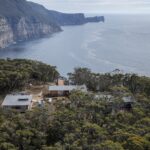
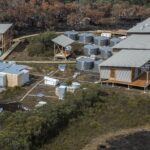
My biggest objection is to any attempts to mandate the use of huts, private or public, as a precondition for undertaking a multi-day walk a la the Three Capes Walk template. At the end of his presentation at the above-mentioned symposium, I asked a very senior NPWS manager why the Green Gully track – a 65-km walk in the NSW Oxley Wild Rivers National Park – is off limits to tent-based walkers. Self-guided walkers are required to move each day between the 5 pre-booked, six-person huts for which solo bookings are not accepted. The cost, though a small fraction of comparable commercial guided walks, is considerably higher than the Overland Track. I got a sheepish reply that this walk’s overly prescriptive regulation is an aberration, a mistake not to be repeated. I fear otherwise. Thank you to Rob Blakers for Three Capes Accommodation Footprint images.

Three Capes 9/11/15

Three Capes 9/11/15


Know your Clubs – YMCA Hobnails

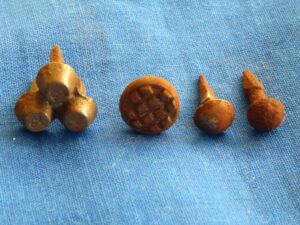
Hobnail Canyon is a short, pleasant canyon located just off the Bell Road past Mt Tomah.  Now hobnails are a kind of boot cleat popular in the pre-WWII era.  They were nailed onto the leather sole of boots to minimise slipping.  Did the first bushwalkers through the canyon wear boots or were they from YMCA Hobnails Bushwalking Club?

From 1952 to 1970 the Hobnails were a club of young men 17 – 21 years of age with a strong reputation.  This club was just one of a strong group of bushwalking clubs in the YMCA during 1950s / 1960s where boys could progress into bushwalking as they grew older.

Young Pioneers included boys 12 – 14 years of age.  These boys could then progress to the Venturers (not Scouts) as they grew to 17 years old.  When my younger brother joined the Venturers in 1969, they were down to just three members and were officially folded up a few years later.  From 18 years of age young men and women (note) could join the YMCA Ramblers.

The YMCA Ramblers were the longest lived of these clubs.  Formed in November 1938 by Harry Black and three others it lost two members in WWII.  At their AGM of 1978 the Ramblers left the YMCA but had a final BBQ at Neilson Park on 23 November 2003.

The Ramblers always had a tense relationship with the Young Men’s Christian Association (YMCA).  Not every member had a tent, so they were often shared including ‘co-tenting’.

‘Old’ Hobnails were meant to progress to the Ramblers except that they mostly didn’t instead going to the Kameruka Bushwalking Club (KBC).   From 1946 to 1988 the KBC were renowned for doing tough and exploratory bushwalks.

So, what did hobnails look like?  Dunlop Volleys sandshoes were all the go for the Hobnails bushwalkers.  I can remember an ex-Hobnail telling me that he could not recognise a hobnail (boot cleat) when he was shown one.

You can find club badges for the Hobnails, Ramblers and KBC among many others at the Bushwalking NSW website club badges page.

Keith Maxwell – Honorary Historian BNSW.


Splendour Rock book

Did you know that there are four other memorials in the immediate area of the plaque at Splendour Rock in the Wild Dog Mountains.  A detailed, fully researched book by Michael Keats and Keith Maxwell is now with the printer.  For any bushwalker with even a passing interest in Splendour Rock this will become a go to reference.

Splendour Rock honours thirteen (13) bushwalkers from clubs who died on active service during WWII. While Splendour Rock has been described as ‘God’s Balcony’ with its views of the Southern Blue Mountains it was not the first choice of a site for a memorial.

The book answers so many questions such as, who were the thirteen (13) young men, how did they die and what did they contribute to bushwalking?  How have they since been remembered?  Who cast the Splendour Rock plaque and when / how was it installed and then dedicated?  Who were the bushwalkers who served and returned?  How were they supplied comforts from home?  What is the story behind the other four memorials.

A great read and a great reference not to be missed.  Watch out for a book launch early in 2023.

Keith Maxwell.

BNSW Honorary Historian.


Lost City walkabout

A weekend walk through the Gardens of Stone lead by Keith Muir

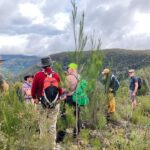
It was an easy start to the weekend staying Friday night at Keith Muir’s place in Katoomba and then being driven to the car shuffle and then to the start of the walk.

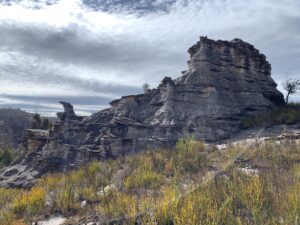
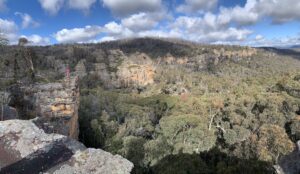
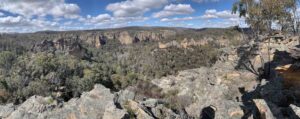
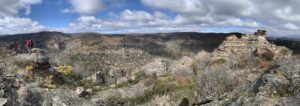
We started walking on broad fire trails that passed through unspectacular heath on the Gardens of Stone State Conservation Area not far from Lithgow. However, before long Keith and the others stopped at a large rock on the side of the road which gave a view over an amazing valley. We were looking down over a huge canyon-shaped valley lined with intricate pagoda structures. The Lost City. It truly was reminiscent of an ancient city with each pagoda-shaped ‘tower’ with its rounded ‘head’ and ironstone fenestrations.

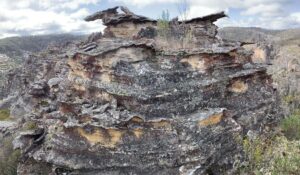
We walked down the hill into the valley and the view of the Lost City just got better. As we got up close to the structures you could see the sandwiched layers of ironstone and sandstone. With the sandstone weathered away leaving the ironstone jutting out.

In places the ironstone was twisted and curled up making even more beautiful structures.

We walked through the valley floor which was filled with beautiful bush before Keith identified a ridge which we could climb to reach our campground. The climb was a steep scramble at times and we needed to find our way around some rock formations but we made it without a hitch. Keith really knows this area well.

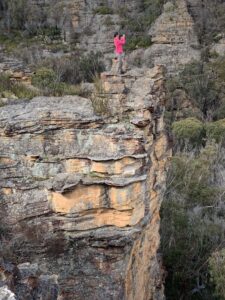
We walked across the plateau and then climbed up more pagoda formations. Getting close enough to the pagodas to climb them makes you super aware of how fragile they are. The ironstone layers that jut out and give the pagodas their intricate decoration are unsupported and easily break off. We were extra careful with every step to be sure we didn’t break off rock as we climbed.

After admiring the view from the top we headed across the plateau to our campground in a lovely clearing near a water soak. We enjoyed our meals around a campfire and headed to bed early to get a good rest.

On the Sunday Keith lead us on a circuitous route through another canyon-like valley surrounded by pagodas. The bush was beautiful and we all enjoyed our lunch beside a beautiful pagoda. We then walked out to the car shuffle car with no trouble.

I’m so grateful to Keith for showing me this precious part of the world. Having seen the pagodas from afar and up close, and having seen how fragile they are, I am inclined to write to NPWS and ask that they:

  1. ban people from walking or climbing the pagodas of the Lost City, and
  2. develop walking tracks that pass close by the pagodas so people can enjoy them.

If this area is opened up to mass tourism, with people allowed to climb the pagodas, I can see their delicate ironstone protrusions getting snapped off until there are no more protrusions giving the pagodas their delicate filigree-like decoration. Surely we need to take care of these delicate structures to the next generations can enjoy them as we do.

Have your say on Facebook or by email to admin@bushwalkingnsw.org.au.

Lightweight Hiking

Lightweight Hiking

As we all know, the lighter your pack, the more you will enjoy your multi-day hiking adventure in Australia or overseas.

With this in mind, Byron Community College recently ran a Lightweight Hiking Course which gave participants expert advice on choosing the lightest affordable equipment and dehydrated food.

A highlight of the Course was a gourmet hike cooking class with dishes such as:

  • Miso soup
  • Linguine with speck, hard fried in ghee and garlic and embellished with fresh snow peas and shaved parmesan
  • Thai rice with coconut milk, lemon grass, snow peas and chilli tuna fillets
  • Chocolate chia pudding with coconut milk
  • Billy tea

The Course also included a local day ‘off track’ hike and the option of overnight camping and hiking experience.

The Lightweight Hiking Course was presented by Steve Millard from Byron Hikers who has extensive experience planning and leading hundreds of hikes all over Australia and the remote Indian Himalaya. Steve loves sharing his knowledge to encourage more people to experience the simple pleasures of hiking in the wilderness. Most importantly Steve wants more people to become aware of the need for conservation of our precious national parks and natural areas. Email Steve at byronhikers@gmail.com for more information.

This lightweight hiking class will run again through the Byron College in February/March 2023. For those keen to learn more hiking recipes the book Xtreme Gourmet has lots of information on ‘high energy, lightweight recipes for the outdoor enthusiast’.